



Energy, Water & Utilities | Thought leadership


62% are trying to reduce how much water they use and 60% have already installed energy-efficient light bulbs in their homes.
As crises become more and more immediate, sustainability is the culprit that gets pushed to the back of the agenda more and more frequently. With war, economic challenges, and the ever-changing landscapes of industry sectors, behavioral shifts have become a constant.
But ultimately, the world’s many problems pale compared to the existential threat that climate change holds against our communities.
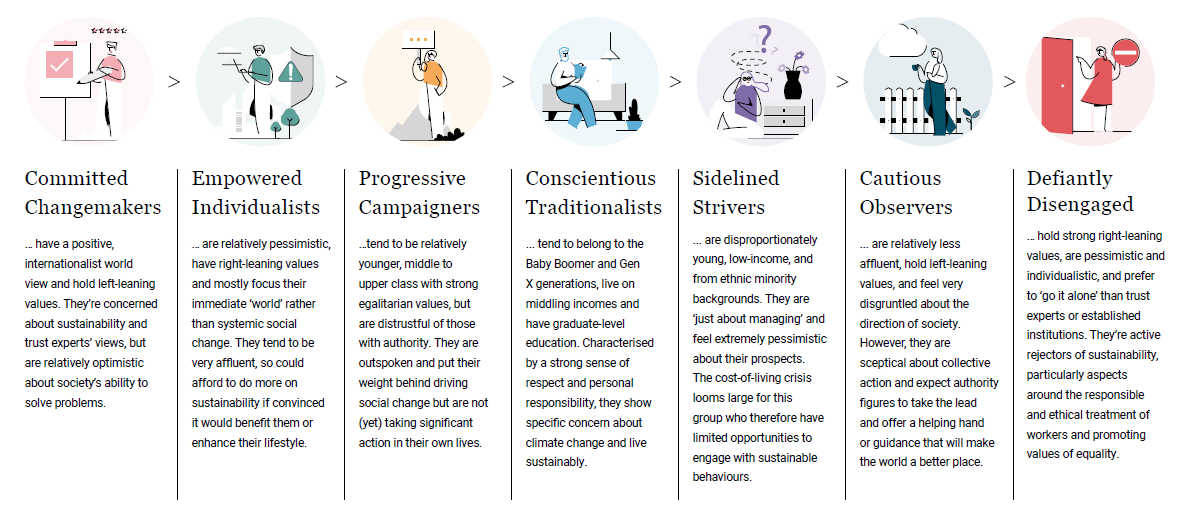
Savanta’s 2022 Eco Segmentation studies how society is embracing, or resisting, a desire to meet sustainable goals, even during a deep and global economic crisis. For businesses to understand what choices consumers make and where they fall complacent for the sustainable alternative, they must first understand what values consumers hold dear and what intrinsic behaviors they possess.
Our segmentation shows that in their intensions and actions towards sustainability, the public falls into seven segments; from Committed Changemakers who have a positive, internationalist world view and holds left-leaning values to the Defiantly Disengaged, those holding strong right-leaning values, who are pessimistic and individualistic and prefer to ‘go it alone’ than trust experts or established institutions.
The report breaks down consumer behaviors across sectors to determine where sustainable practices shift from intention to action. Sustainable usage across home and energy brands has proven difficult, with an ongoing energy crisis still heavily restricting competition for home utilities.
Cost is top of mind for all segments, but the events of 2022 have for the first time made visible to consumers the link between renewables, energy security, and lower prices in the long-term.
Currently, only the most affluent segments feel able to prioritize renewable energy. Over half (55%) of Committed Changemakers cite where a supplier offers renewable energy as important criteria and 61% have chosen a ‘green’ tariff. It’s a similar story for Empowered Individualists—51% say it’s important and 52% have selected one. In contrast, a similar proportion (46%) of the liberal but lower-income Progressive Campaigners say renewable energy is an important factor in their decisions, but only 22% have chosen such a tariff.
There is more that consumers can do right now though, regardless of their energy tariff type or cost. Many are taking steps to reduce their energy usage. For example, 62% are trying to reduce how much water they use and 60% have already installed energy-efficient light bulbs in their homes. These energy-saving behaviors appear to be driven by frugality rather than sustainability, with Conscientious Traditionalists (78%) and Cautious Observers (68%) outperforming the more affluent Committed Changemakers (62%) and Empowered Individualists (37%) on using energy efficient lightbulbs. However, even here there are missed opportunities. Only 29% of Sidelined Strivers use these, and they are more likely than any other segment to have never heard of them (14%). These are quick ‘win-wins’ better for both planet and consumer wallets, and more should be done at a government and industry-level to spread awareness of these products.
In the US and Canada, while the majority (58%) only use air conditioning when absolutely necessary, 42% have it on most days. The otherwise well-intentioned Empowered Individualists are the worst offenders here, with 53% using their air conditioning most days.
Yet as we cool our homes, we warm the planet. Air conditioning units’ chlorofluorocarbons contribute to climate change and the demand for air conditioning is predicted to triple by 2050. There is hope though— growing adoption of low-carbon heat pumps, which can also provide air conditioning may improve the situation in the long-term.
Cooling or heating buildings is expensive—even more so when energy goes to waste. Longer-term, consumers are starting to ‘think big’ when it comes to energy efficiency and security. Nearly a quarter (23%) have already installed extra cavity wall or roof insulation, while a third (33%) would consider it, something which is true across all segments, so there’s universal appetite.
The most popular long-term renewables idea is installing solar panels, with nearly half (45%) in our research considering it, even 43% of the Defiantly Disengaged. But overall, only 9% have done it, likely due to the high upfront cost. Committed Changemakers (34%) have taken this step en masse, as well as 18% of Empowered Individualists. These segments are among the relatively wealthier, demonstrating that if consumers have the funds, they’re prepared to invest wisely in the name of long-term savings and energy sustainability.
The right initiative is required though. Initiatives in the US are predominantly at a state level, such as under the guise of ‘weatherization’ rebates in Wisconsin, but have received a boost from the Inflation Reduction Act which included significant investment in home retrofit. Although these initiatives have reached national audiences, more must be done to publicize such initiatives.
The report is based on the findings of a survey of 12,016 adults aged 18+ in the United States (5,006), United Kingdom (5,005), and Canada (2,005). Data are weighted to be representative of age, gender, region and income/education (US and Canada) or social grade (UK).