





Lesson 1: Tech everywhere, all at once
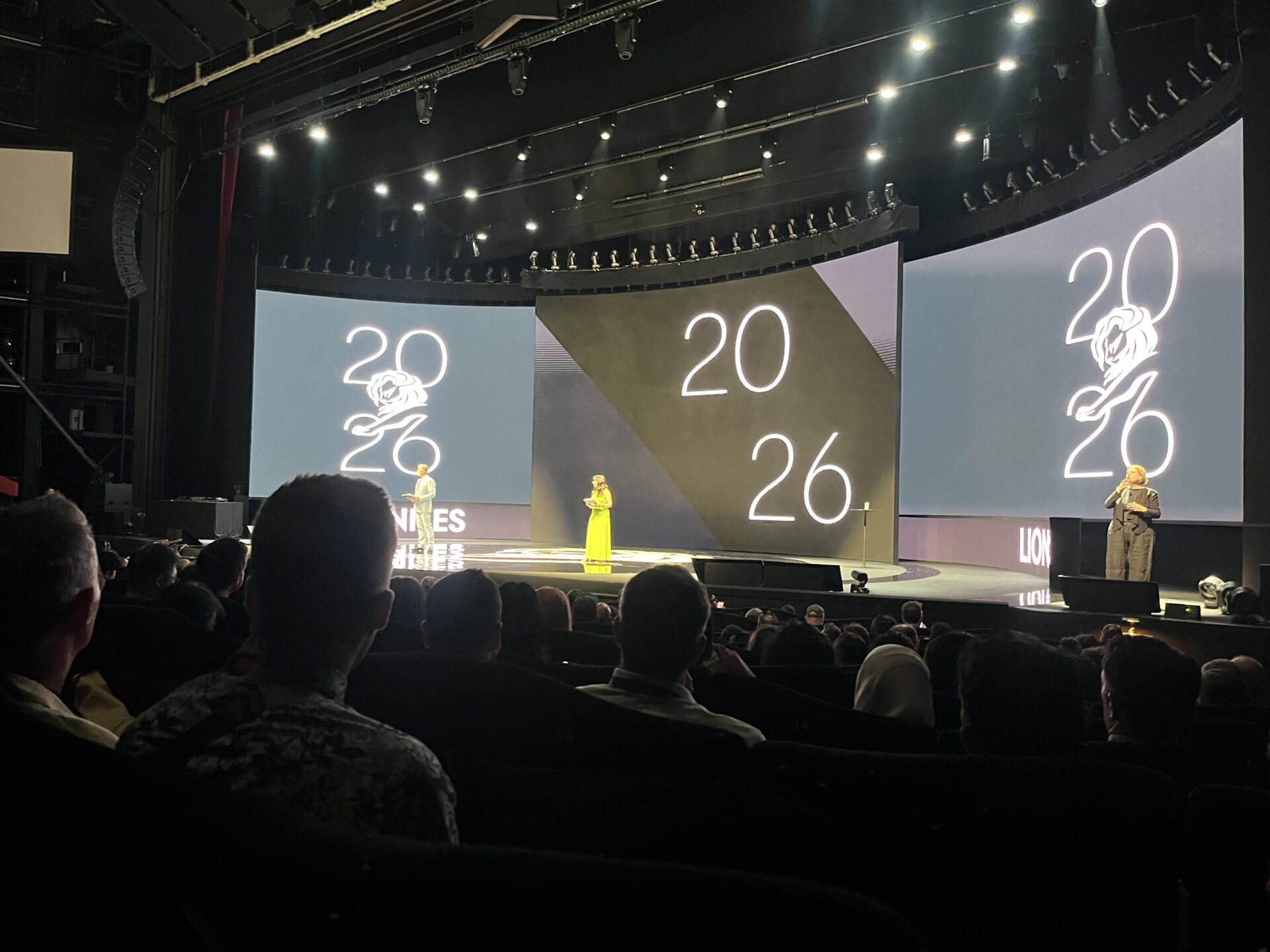
One thing quickly became obvious in Cannes: tech is no longer sitting on the sidelines of creativity; it is now embedded in it. As Sir John Hegarty laughingly said, “The tech guys are everywhere in Cannes now. You can’t get to the beach anymore because of them.” Jokes aside, it really did feel as though almost every talk or panel touched on AI in some form.
What struck me was how the conversation around AI has matured. AI is now being treated less as a distant disruption and more as an immediate reality. The focus has shifted to practical application: changing workflows, speeding up production, reducing friction and enabling scale.
During his talk, Demis Hassabis of Google DeepMind spoke about AI potentially creating a new human era over the next 10 to 15 years, driven by advances in reasoning, planning and creativity. Whether or not every prediction plays out exactly as described, the broader message was hard to miss: AI is not a passing phase; it is going to reshape marketing in profound ways.
My takeaway: Brands need to get comfortable with experimentation and work out where technology can genuinely enhance what they offer. The challenge now is not whether to engage with AI, but how to do so in ways that create value rather than just volume.
Lesson 2: Relevance at scale is the immediate challenge
If AI is the enabler, relevance is the real test.
One observation that stuck with me at the festival was how hard brands are working to understand people at a much more granular level. At their stands, companies such as Meta, Amazon and Pinterest demonstrated how data and platform intelligence are enabling more relevant, tailored and timely brand experiences.
Personalization is no longer a nice-to-have; it is the expected standard. But Cannes also made clear that simply having more data or better targeting is not the answer. The real challenge is using richer understanding to create relevance at scale without losing clarity or coherence. In increasingly fragmented environments, brands need a clearer strategic core to operate effectively across channels, creators, data sources and algorithmic systems.
My takeaway: Understand what you stand for and be genuinely obsessed with understanding your customers. The opportunity is not simply to collect more information, but to create relevant experiences at scale that still feel like your brand.
Lesson 3: Human community is becoming vital
Another notable theme across the festival was the move towards smaller, more intentional spaces in response to an always-on digital culture.
At an excellent Future Friends network session, one of the most compelling themes was the growing importance of close human community. This reflected a broader shift seen throughout the week: as digital culture becomes noisier and more performative, people are placing greater value on experiences that feel private, local and authentic.
A counter-movement does seem to be underway: less broadcasting to everyone, more selective sharing. Less passive scrolling; more intentional choices about where time and attention go. Less pursuit of scale for its own sake; more interest in spaces, rituals and interactions that feel meaningful.
Brands already seem to be responding. At the Pinterest stand, it was striking how much of the messaging focused on encouraging people to step away from the platform and do something in the real world instead. One line that stuck with me was: “The best thing you can find online is a reason to go offline.” Likewise, the CMO of Hinge talked about its “One More Hour” campaign, which encouraged members to spend time together in face-to-face settings such as reading groups or chess clubs. More broadly, Cannes reinforced that creators, communities, fandoms and live experiences are moving closer to the center of modern brand building.
My takeaway: Brands increasingly need to balance technological advancement with the human need for community, presence and real connection. The challenge is not just to help people do more online, but to recognize when what they really want is something more intentional, embodied and real.
Lesson 4: Maintain brand consistency; it’s the boring thing you MUST love
Among the seasoned presenters at Cannes, one theme emerged: advertising is becoming easier to produce, but often less enjoyable to consume. As technology makes it simpler to generate more assets, variations and content across more channels, the risk is not that brands produce too little – it’s that they produce a lot of work that is technically polished but ultimately forgettable.
That is why consistency matters. As brands show up across fragmented paid, owned, creator-led, retail and live spaces, a clear sense of what they stand for – and what makes them recognizable – is essential. Listening to Mark Ritson and Byron Sharp debate the science behind marketing, it was clear that driving mental and physical availability remains key. The goal is to have a strong enough core that different executions feel unmistakably like the same brand without looking identical.
My takeaway: In a world of automation, fragmentation and content abundance, the brands that stand out will not just be the ones doing more. They will be the ones that are clearest on who they are, most consistent in how they show up, and most creative in bringing that to life.
Lesson 5: Consumer closeness is still the lighthouse
For all the discussion of AI, systems and scale at Cannes, one of the most grounded lessons of the week was also one of the most heartwarming: nothing replaces real contact with consumers. Beneath all the buzz lay one underlying question: “How do we keep consumers at the heart of what we do?”
P&G offered a powerful example. The Chief Analytics and Insights Officer shared that when the new CEO joined, he was in a consumer’s home at 10am on his first day, observing and listening. In a world increasingly shaped by dashboards, models and synthetic summaries, there is still no substitute for seeing real life up close.
But Cannes also reinforced that generating insight is only half the job. The real value comes from turning understanding into something a business can act on – whether a brand story, strategic direction or clearer decision-making framework. I saw this brought to life in a session from the Glanbia Performance Nutrition team. What stood out was not just the quality of the segmentation, but how it was embedded across the organization: combining an AI-enabled persona tool with a simple printed handbook to help the learning travel.
From my own experience, both client- and agency-side, that felt like an important reminder. Great insight has the most impact when it is designed not just to inform, but to endure – shaping everyday decisions rather than sitting unread in a shared folder.
My takeaway: The pace of change can make planning for the future feel overwhelming. But in a world of dashboards, models and synthetic summaries, the organizations that stand out will be those that use these tools to stay closest to real people.
The future of marketing won’t be won by technology alone. AI is reshaping the system quickly – and the brands that win will be those that stay closest to people, clearest on their brand, and most committed to staying relevant, memorable and human.
Want to explore what that looks like for your organization? Get in touch with our team – we’d love to talk.